Swallowed Shoes in a River of Absurdity
A philosophical analysis of Sadanand Rege’s Old Leaves from the Chinese Earth
In the Third Century BCE, Zhang Liang crossed paths with Huang Shigong, a former minister of the tyrannical Qin Shi Huang, on a wooden bridge. Huang Shigong tossed his shoes into the river below thrice. And three times Zhang Liang retrieved his shoes in tempered anger. Sufficiently impressed at the humility and fortitude of Zhang Liang, Huang Shigong passed along his lessons of rule for Zhang Liang to bring peace and prosperity to a chaotic China. He asked Zhang Liang to return in 13 years. 13 years later, Huang Shigong was nowhere to be seen, so Zhang Liang returned to the ministerial seat of the Han dynasty and got to work.
Two millennia later, Sadanand Rege hears a story twice translated of Chiang Liang, who met an old man on a wooden bridge. The old man tossed his shoes into the river below thrice. And three times Chiang Liang retrieved his shoes. The old man asked Chiang Liang to return after 13 years. 13 years later, the old man was gone, so Chiang Liang peered into the river and saw nothing but his reflection hidden behind the glare of the sun. From somewhere inside himself, the voice of the old man whispered to Chiang Liang, “One shoe is life, the other is death…”
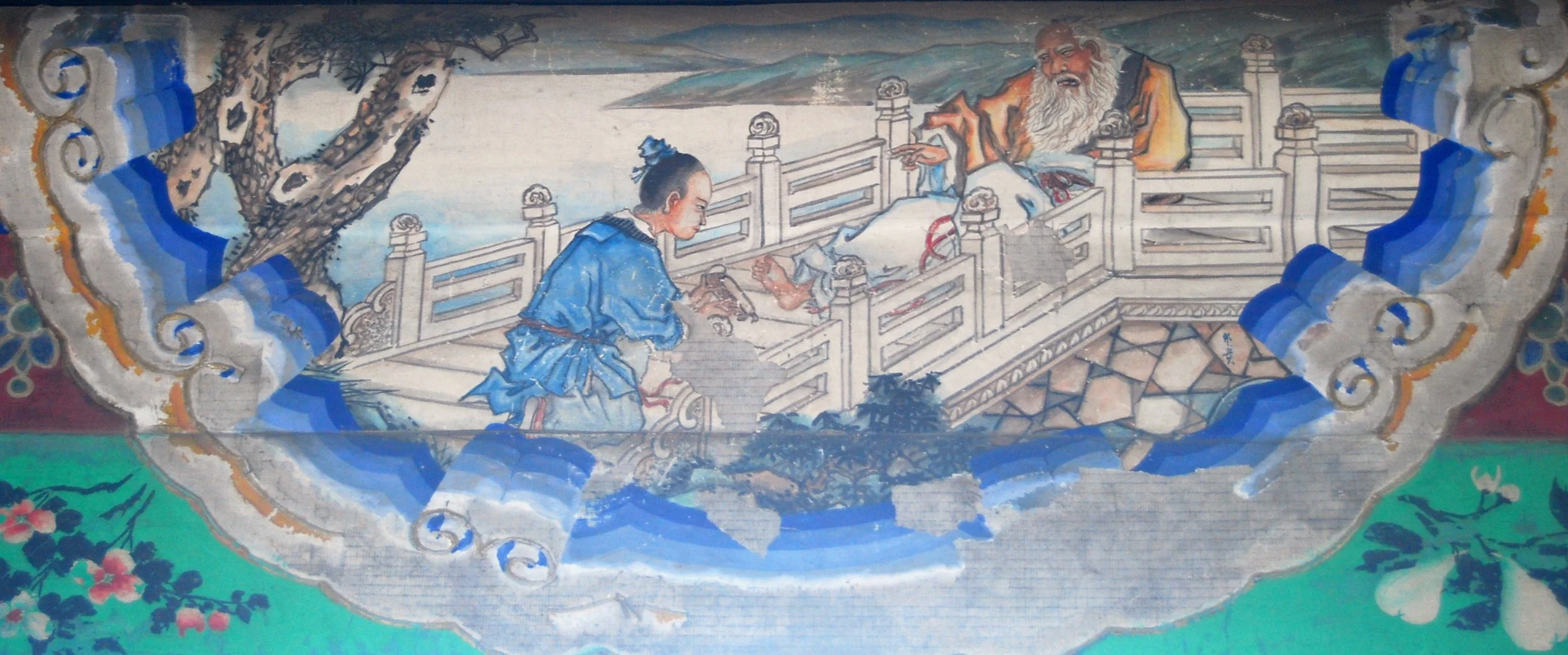
Rege’s account of Chiang Liang’s story testifies to human agency of faith, far from the historical meaning of the story praising humility. When Rege refers to the shoes as life and death, the image of Chiang Liang leaping into water in which the shoes were cast resembles one of a leap of faith. Thus, Rege invites readers to consider faith and humanity. Rege’s argument, however, is more complicated than ‘people should lead their lives and their death in faith.’ The poet matures the question of faith by proposing that faith to humans is determined our own agency. When Rege writes “But someone spoke out of my bones,” it becomes unclear whether the old man from Chiang Liang’s memory was real. It also does not matter whether the old man was real, as it was not a voice from outside which compelled Chiang Liang to dive into the river, but one from inside. Further, as Chiang Liang witnesses his reflection hidden behind the glare of the sun, Rege shows that the mystical is at best obfuscating our internal belief, or at worst a distraction from ourselves.
Rege makes a substantive positive argument to place agency in meaning into the hands of individuals. Rege further makes a formal negative argument to take meaning out of the hands of culture and religion. Following the title of the poem, Rege writes a tercet explaining that this story has been told to him by a man in Japanese translating it from a Chinese book. Rege eventually writes the poem in Marathi. The opening tercet thus becomes structurally imperative to understand why the historical meaning of the story is absent in Rege’s poetic rendition. Rege showcases how the meaning behind a story can shift as it passes between people. What previously was a story to emphasize a moral responsibility towards humility and fortitude transformed into one of faith and agency. In emphasizing the vulnerability of stories to change in meaning, the external strength of a story, culture, or religion is pulled into question. Rege thus questions human collective belief, urging readers to be critical of truth externally imposed, and to acknowledge each person’s own role in shaping their decisions and commitments to life and death.