Déjoué
The Somewhat Circular Stance of Déjoué
Much of our understanding of human history comes from the observation and analysis of art and art pieces; from these observations, inferences and claims about the time from which it was made can be built. By building claims about history based on art from the past, historians do history not merely from the art in the space of itself, but rather art in the space of the observers understanding of the context which surrounded the art when it was made, and the context which surrounds the art now. Art is made once at the time of its inception, then once more at the eyes of an observer. Ancient Greek pottery artists did not make their work for the purpose of being displayed in the British Museum to be analyzed by historians two and a half millennia later. However its intention as art may differ, it cannot be denied the impact which its observation holds. This points towards the conclusion that art as art, and art as art being observed are two distinctly different things. I argue that based on this premise, along with the notion that art itself can do philosophy, then works of philosophy can themselves be separated distinctly as works of philosophy and works of philosophy as interpretations in the same way art can. I will be using my position as author of my short film Déjoué, to articulate and defend these two premises, to prove my claim.
To begin, let’s examine the role that intentionality of author has on the legitimacy of art. Noël Carroll (whose two pieces on the legitimacy of film as art, and of art as philosophy inspired me to question the relationship between philosophy and observer) argues that photography and film are representational arts by attacking Scruton’s notion that film is not a representational art through the use of three arguments. The first of these three arguments; of causation, addresses Scruton’s position that “art require[s] the creative, expressive, and/or interpretive input of an artist.”[1] In this argument, a skeptical position of film as art would argue that art as a representation requires an expression of thought. That is to say, a picture of a sunset is different from the sunset itself in the way that art requires intentionality in its representation. Both might be considered beautiful, but only the former can be called art. The artist exercises their intentionality by choosing where and when to photograph the sunset, along with the composition of the shot. The artist is expressing their appreciation for the natural scene by capturing it in photograph. While I will not argue one way or another for the legitimacy of Scruton’s argument, the idea of intentionality being necessary for the creation of art does bring with it some interesting connotations.
Should intentionality be a necessary feature of art, or at least representational art, then that is obviously to say that every piece of art has intention to it. However, a statement as blanket as that feels cavalier; at least with the definition of intentionality we are used to. For Scruton, intentionality is not to say that every piece of art must have some greater meaning to it, but rather to say that it was not made by complete accident. It might be appealing at this point to end the idea of intentionality here, and to agree each piece of art was made with intentionality, but I would argue that beyond just being made with intention, the author has baked inside the art itself this feature, and that it cannot be separated. Let’s take an ancient Greek vase for example, it is made at the hands of an artisan, who goes through the process of wheel throwing, baking, and painting the vase. The vase is appreciated and shown at the home of its maker, until the time that it they die, upon which is transfers hands for the next couple millennia, before ending up behind a glass wall, with a plaque in front reading the meaning behind the paintings on the side. Somehow, the impression that there is some meaning behind the design of the vase has been decided and decoded for people to appreciate. However, even if this vase clearly shows Heracles wrestling a lion, it is impossible to be certain that the author of the vase meant for it to be a reference to the story. There is a non-zero chance that the vase maker lived completely alone on some island in the Aegean, and had never heard of such myths, just decided that it would look unique to have a man wrestling a huge cat on the side of his vase. It is this exact uncertainty in art which makes us unable to ever be sure about the genuine intentions of authors, no matter how obvious it may seem. Therefore, we must take this into consideration when defining, and categorizing art, in the sense that we (i) each piece of art must have intention from its creator, and (ii) we cannot ever be positive what the intention is, therefore, art qua analyzing art is distinct from the art itself, in terms of its status as a representation.
In my short film, it is my goal to emphasize the distinction of analyzing art, and art itself through the use of formal features of film. When planning, I wanted to test the theoretical concept of losing a language to time. More so, to take advantage of the medium I am working with to emphasize the misplacement of intentionality and meaning. Essentially, my guiding question is does a book which is written in a language no longer understood by anyone still have meaning? If it does, is the meaning different than one which we might be able to decipher from the tools at our disposal?
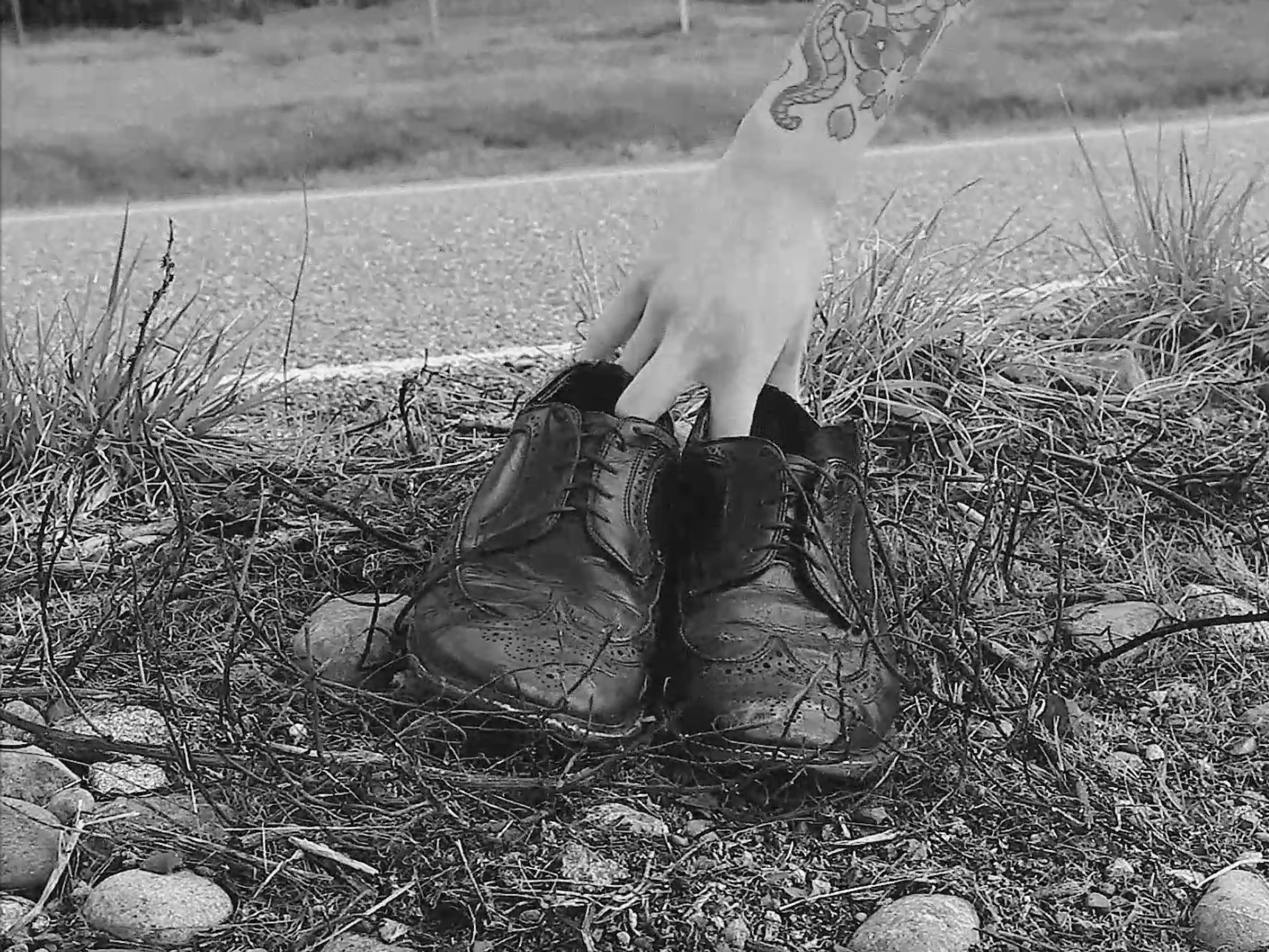
I came to the conclusion that through the manipulation of editing, it feels possible to replicate this theoretical experiment about obscured meaning. To begin, I planned a pretty simple short about a person who continually sees someone who looks oddly similar to themselves outside his house. Throughout the short, perspective shifts back and forth between the characters and culminates in an attempted confrontation by the character from inside the house, to the person watching. However, after the person outside seemingly vanishes, the man from the house takes off his shoes and swims out into the ocean. During this scene, a disembodied hand picks up the pair of shoes left on the shore, which we had seen both characters throughout the film wearing.
The goal was to make a film that could have at least a couple meanings. The first is that there is no relation between these characters, and this is just one person stalking a second, who wants to steal another pair of shoes to add to his collection. The second could be that it is some sort of strange time sequence not too dissimilar to The Meshes of the Afternoon, which leaves behind an ambiguous message about a person going back in time to watch themselves and how they used to be (hence the title Déjoué, which is French for Foiled, a nod to not only the fruitless chase sequence, but also the literary device of contrasting characters). A third could be the most abstract, where it depicts one person who sees visions of himself, and chases after his visions in a sort of self-realizing journey kind of a story.
By having these different meanings, I intend to force the audience to be participatory in the story. It is up to the observer to dictate their own meaning. However, to do this alone would be a story told many times over, and also one that doesn’t quite capture the distinction I am going after. To replicate the complete loss of understanding of the original author, and to provide the audience with tools but not certainty to work with, instead of leaving the film as it was originally shot, it the second, philosophic cut, the film’s scenes are spliced into a completely random order. This forces the audience to attempt to put the scenes together into an order that makes sense to them, then to analyze based upon their personal concoction. By having the audience play the role of decipherers of a lost language, I hope to push them to consider the validity of their interpretation not as definitive, but rather as satisfactory and satisfying. I also hope to shine light on the fact that there is a goal, and definitive meaning and order of the scenes according to the author. However, this does not make the audience’s interpretation wrong in any sense, but rather just differently nuanced from the author, thus allowing the film to exist in two different ways at the same time. The first under art qua analyzing art from the eyes of the audience, and the second under art as itself, through the eyes of the author.
Now, through the assistance of a conveniently made film, we have seen how art can exist as two things at once. However, to make a claim that this is representative of philosophy in the same way, it is first necessary to prove that art can even do philosophy in the first place. Carroll, on Philosophizing Through the Moving image: The Case of Serene Velocity, helps provide some useful parameters which are often cited as reasons against the case of films as philosophy. The two important criteria, which most feature length films tend to lack, are the originality of philosophic ideas, and the use of the film medium to portray those ideas.[2] Originality is the more difficult of the two criteria to pin down and is regarding the idea that a film has to provide philosophic argumentation, or knowledge which has not previously been done before. The point of this objection is to discredit films who may use actors to recite the philosophic points of the writer, or some theory, thus “not authoring philosophy firsthand, but merely parroting it,” however by limiting the philosophic threshold to only new ideas opens a can of worms about what has an hasn’t been said before.[3] Keeping that in mind, limiting original ideas to meaning that the idea is at least original to the author, and first depicted within the film, not some other piece of work by the author, then this point seems fair. Secondly, the use of the film as a medium is to say that philosophy cannot just be read out loud in a poem by a character on screen, meaning that some feature which is essential to the medium of film must be taken advantage of to qualify the philosophy as being done by the film.[4] Lastly it seems notable to mention that issues surrounding the impracticality of empirical philosophy don’t matter so long as the subject matter stays conceptual.[5]
So, where does Déjoué stand on this scale? Firstly, the case for original philosophy. As the author, I can attest that the claims I wish to make in the film are not based upon some prior written theory, either by myself or some other author. While the question of intentionality of author, or relationship between audience and art is not a new concept, the particulars with which I pose the concepts is not in a way that I know has been before, and also is not simply recounting a thesis I had prior made and is supplementary. Perhaps I do not have the same accredits of Serene Velocity in it’s first to the line philosophy regarding the essence of movement in film, but for what seems like a reasonable height to set the hurdle of originality at, I don’t see how Déjoué is merely parroting some previously written theory. Secondly, the use of essential features of cinema to portray the philosophy. While the meaning of my film itself might be one captured in narrative not dissimilar to silent theater, the greater philosophic argument regarding the relationship between the audience’s perception about their relationship to the film, and the author’s is conveyed through the use of rearrangement of scenes in editing. By editing the film to have the clips be in random order, it forces the audience to put together a puzzle, and it is through the process of piecing together the scenes do the philosophic points take shape. It is not obvious, or even necessary to come to the conclusions I hope to lead the audience to, but I would claim that this is justified for two reasons.
The first is that we cannot expect everyone to be able to come forth with the exact interpretation from every piece of art as the author wants them to, and the second is that exact rift between author intentionality and audience participation is the one I hope to highlight. By coming to conclusions, I as the author do not intend, the audience, in a roundabout way, ends up back at the spot I want them to be at, just without the extra step of forming the clear theory in their heads. The point of the art is to show a distinction between audience conclusion and author intention, so by the audience being confused, and coming to a conclusion which I did not intend, they still are forced to engage with the process of deciphering intent, thus engaging with my philosophic claim. Not everyone will come out thinking that they have discovered the idea I want them to, but by coming to at least some sort of conclusion, they have given my art legitimacy as a separate entity from art qua analyzing art.
If these arguments are convincing, then I ask for one more step further, and to view Déjoué not only as in reference to art vs observation of art, but also as philosophy vs interpretation of philosophy. I’ve shown that Déjoué follows the essentials Carroll outlines as necessary for a film to do philosophy. Then by following the same logic, should we count philosophic works as a kind of art themselves, in the same sense that ancient Greek vases are art, or films are art, then works of philosophy follow the same rules art does, where they exist at once as philosophic ideas and at the same time philosophic ideas qua analysis of philosophy.
[1] Noël Carroll, “Philosophizing Through the Moving Image: The Case of Serene Velocity,” The Journal of Aesthetics and Art Criticism 64, no. 1 (Winter 2006): 7.
[2] Carroll, “Philosophizing,” 174.
[3] Carroll, “Philosophizing,” 174.
[4] Carroll, “Philosophizing,” 174-175.
[5] Carroll, “Philosophizing,” 176.